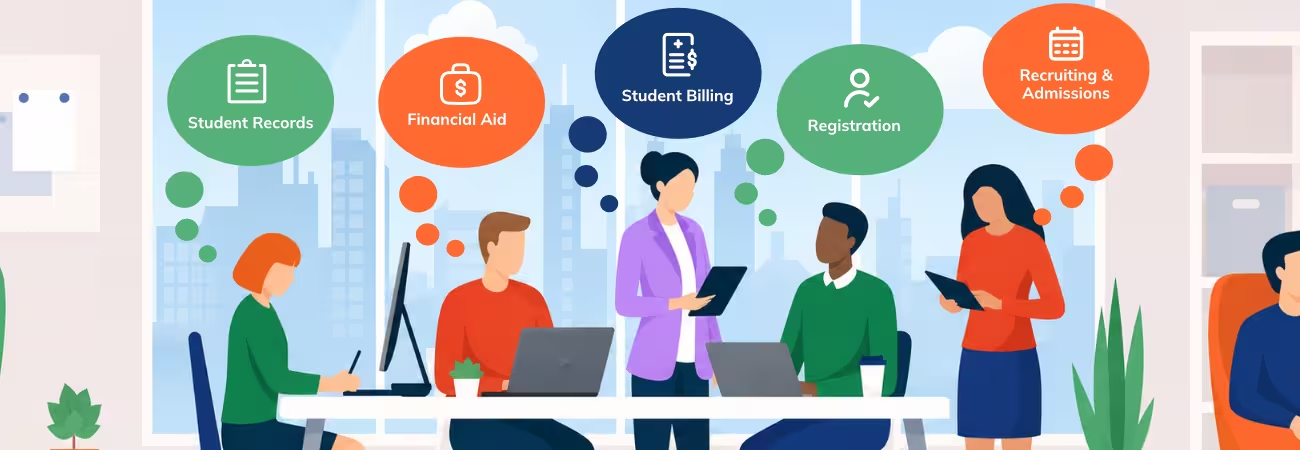
If you work in higher education, you have heard the term more times than you can count: student information system, or SIS. But ask five people on a campus to define it, and you will likely get five different answers. Some describe it as the system that holds student records. Others point to registration. Others think first of student billing or financial aid. All of them are right, and all of them are incomplete, because a student information system is not a single feature. It is the operational backbone that connects every one of those functions into one coordinated system.
This blog breaks down exactly what a student information system is, what institutions should expect from one in 2026, the benefits a well-built SIS delivers, and how to evaluate whether a given platform, including Student First, is the right fit for your institution's future.
A student information system is the software platform higher education institutions use to manage the full student lifecycle, from initial inquiry and admissions through enrollment, academic records, financial aid, student billing, and eventually graduation. It is the system of record for student data, and it is typically the most heavily used piece of technology on a campus outside of email.
In practical terms, an SIS is the connective layer between departments that would otherwise operate on separate spreadsheets, separate logins, and separate versions of the truth. Admissions, the records and registration office, financial aid, student accounts, and academic advising all rely on the same underlying student information system, even though each department interacts with it differently.
The term is sometimes used interchangeably with student management system or campus management system, and it overlaps with, but is distinct from, a learning management system (LMS). An LMS manages coursework and instructional content. An SIS manages the institutional record: who a student is, what they are enrolled in, what they owe, what aid they qualify for, and what progress they have made toward an academic goal, credential, diploma or degree.
A student information system is not just software that stores student data. It is the operational infrastructure that determines how quickly an institution can enroll, support, and graduate the students it serves.
The expectations placed on a student information system have changed considerably. A system that was considered modern a decade ago is, in most cases, no longer adequate, and institutions evaluating an SIS in 2026 should hold platforms to a higher standard across several dimensions.
Cloud-native architecture
The platform should be cloud-native from its original architecture, not a legacy system with a modern interface layered over older infrastructure, and not several older, separately built systems stitched together through acquisition over the years. Cloud-native architecture is what allows an SIS to deploy updates continuously, without scheduled downtime, and to scale as an institution grows.
Frequent, low-friction updates
Compliance requirements change constantly. Institutions should expect their SIS to reflect new federal and state requirements through frequent releases, not a multi-month development queue.
A unified data architecture
Admissions, records, financial aid, and student billing should operate within a single system, not a patchwork of modules that require manual reconciliation to keep records consistent.
Native multi-campus and multi-brand support
For institutions with multiple locations or brands, the SIS should support that structure natively, not through custom workarounds that need to be rebuilt every time a new campus or location is added.
AI-driven efficiency, with human oversight
Artificial intelligence now plays a substantial role in compliance monitoring, auto-awarding, and reporting accuracy, but institutions should expect that AI to be human-verified, not a black box making decisions without oversight.
A partnership, not a transaction
The relationship should not end at go-live. Institutions should expect ongoing support from a team that understands their specific configuration and priorities, not a ticket queue that anonymizes every request.
Student First's SIS Evaluation Guide outlines the full framework institutions can use to evaluate a platform against these expectations. Download it here.
When an SIS is built well, the benefits extend far beyond convenience. They show up in institutional outcomes that matter to leadership, faculty, and students alike.
An institution running on a fragmented or legacy system does not just lose efficiency today. It accumulates technical debt and manual workarounds that become harder to unwind the longer they persist. The benefits of a modern student information system work the opposite way: they compound over time, making each year on the right platform more valuable than the last.
Most institutions do not evaluate an SIS often, which means the decision carries outsized weight. Choosing the right platform means looking past the feature list and evaluating architecture, compliance capability, and the strength of the ongoing partnership.
Student First was built as a true cloud-native student information system from its original architecture, not modernized after the fact. That distinction shapes everything downstream. Financial aid, student billing, and enrollment management run within one unified platform rather than a collection of loosely connected modules, which eliminates the reconciliation work that comes from data living in separate systems.
Compliance and feature updates ship on frequent release cycles with zero downtime, so institutions are not waiting on a development backlog when federal or state requirements change. Multi-campus and multi-brand support is native to the platform, which means new campuses onboard consistently rather than requiring customizations every time the institution grows.
Student First's AI-First, Human-Verified approach applies artificial intelligence to compliance monitoring, auto-awarding, and reporting accuracy, while keeping trained staff in the loop on the decisions that matter most. And because Student First is an independent, mission-driven company rather than one product inside a larger portfolio, product roadmap decisions reflect the needs of the institutions actually using the platform.
Student First is built to be the right decision not just at signing, but for every year that follows. That is how we earn being called The Future-Ready SIS.
For institutions asking what a student information system should look like today, the answer is a platform that unifies the full student lifecycle, keeps pace with compliance without manual workarounds, and is backed by a team that treats the relationship as a partnership rather than a support contract.
Explore Student First's full platform capabilities or schedule a conversation with the Student First team to see how it fits your institution's specific needs.
If your institution is exploring what a modern student information system should do, and what it should feel like to run one day to day, the Student First team is ready to walk through it.